When you have a garage, basement, house, or renovation full of unwanted material, two options usually come to mind: dumpster rental or junk removal. They solve the same basic problem, but they work very differently.
A dumpster gives you a container and time to fill it yourself. Junk removal gives you a crew that loads, hauls, and disposes of the material for you. That difference affects more than convenience. It changes your total cost, workload, schedule, space requirements, and even which materials make sense for each service.
The cheapest advertised option is not always the cheapest way to finish the entire cleanup.
A better question is:
Do you want to pay for a container and do the work yourself, or pay for someone else’s labor and have the material disappear in one visit?
For large, ongoing projects, a dumpster often makes sense. For smaller jobs, bulky furniture, difficult access, or situations where you do not want to lift and load everything, junk removal can be a better fit.
There is also a third possibility that many comparisons overlook. Sometimes the best option is neither. Municipal bulk pickup, donation, recycling, resale, or a small DIY disposal run may handle part of the job at a lower total cost.
Dumpster Rental vs. Junk Removal at a Glance
| Factor | Dumpster Rental | Junk Removal |
| Who loads the material? | You | Removal crew |
| How long does it stay? | Usually several days | Usually one scheduled visit |
| Labor included? | Usually no | Usually yes |
| Best for | Large or ongoing projects | Smaller or labor-intensive jobs |
| Renovation debris | Often a strong fit | Depends on provider |
| Furniture removal | Possible, but you load it | Strong fit |
| Heavy lifting | Your responsibility | Crew handles it |
| Timeline | Flexible | Appointment-based |
| Space | Container needs placement space | Truck needs access |
| Main advantage | Capacity and flexibility | Convenience and labor |
| Main drawback | Physical work | Higher service cost for larger loads |
The important distinction is simple. Dumpster rental buys you space and time. Junk removal buys you labor and convenience. Once you understand that, the rest of the decision becomes much easier.
What Is a Dumpster Rental?
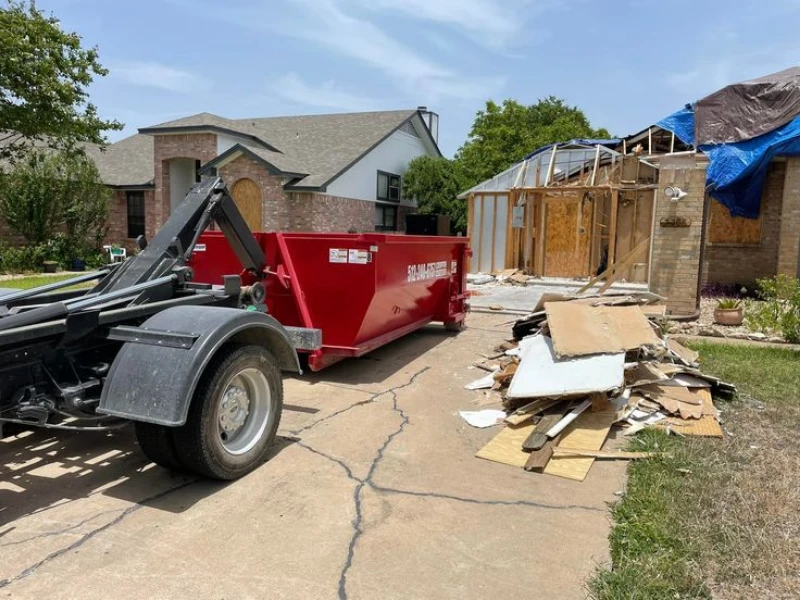
A dumpster rental places a container at your property for an agreed rental period. You load the material yourself. The provider then returns to pick up the container and handles the next stage of disposal or processing.
This arrangement works well when debris appears gradually. For example, imagine you are remodeling a bathroom. On Monday, you remove old cabinets. On Tuesday, you tear out flooring. On Wednesday, you remove drywall. Over the following days, more debris appears.
With a dumpster on site, you can place material inside as the project progresses. You do not need to create a large pile somewhere else or make repeated trips to a disposal facility.
Who loads a rented dumpster?
Usually, you do. That is one of the biggest differences between dumpster rental and junk removal.
You may need to:
- Carry furniture
- Break down larger items
- Move debris from inside the property
- Lift bags and boxes
- Load construction materials
- Arrange the container efficiently
- Stay within weight and fill requirements
That labor has value.
If you have several strong people available and plenty of time, it may not bother you. If you are working alone, dealing with stairs, or trying to finish the cleanup after work, the calculation changes.
What Is Junk Removal?
Junk removal is a full-service hauling option. You schedule a crew, they arrive at your property, load the unwanted material, and haul it away. Depending on the provider, they may remove furniture, appliances, mattresses, household clutter, yard debris, and certain renovation materials.
The biggest advantage is obvious. You do not have to load the truck yourself. That matters more than many people realize. A couch sitting beside your driveway is easy to describe.
Getting that couch down two flights of stairs is a completely different job. The same applies to refrigerators, large cabinets, exercise equipment, mattresses, heavy furniture, and awkward construction debris.
What does junk removal usually include?
A full-service job can involve:
- Labor
- Loading
- Carrying
- Hauling
- Transportation
- Disposal
- Recycling or donation when available
The exact scope varies by company.
Always ask what is included before accepting a quote.
Dumpster Rental vs. Junk Removal Cost
Cost is usually the first question people ask. It is also where many comparisons become misleading. Current 2026 pricing guides show substantial variation in both dumpster rental and junk removal prices. Published national estimates differ because companies use different pricing models, service areas, rental periods, weight allowances, labor structures, and disposal arrangements.
That means you should treat national averages as orientation, not as a guaranteed quote. The more useful approach is to understand what you are actually paying for.
Dumpster rental cost factors
Your dumpster price can depend on:
- Container size
- Rental duration
- Location
- Included weight
- Material type
- Disposal fees
- Overage charges
- Extra rental days
- Delivery requirements
- Pickup arrangements
- Permit requirements
A low advertised rental price can become much higher if your project produces heavy material or exceeds the included weight.
Junk removal cost factors
Junk removal pricing can depend on:
- Amount of material
- Truck capacity
- Number of workers
- Labor requirements
- Furniture size
- Appliance type
- Stairs
- Distance from the truck
- Access conditions
- Disposal requirements
- Same-day service
- Special handling
This explains why two people can describe almost identical cleanouts and receive very different quotes. Their properties may not have the same access.
Their material may not weigh the same. Their local disposal costs may differ. Their providers may also use completely different pricing models.
The Real Cost Is More Than the Service Price
This is where the comparison gets interesting. Suppose a dumpster costs less than a junk removal truck. That does not automatically mean the dumpster is cheaper for your project. You still have to load it.
Imagine a weekend cleanout that requires:
- Sorting
- Carrying
- Furniture disassembly
- Loading
- Multiple trips from the basement
- Moving heavy items
- Sweeping and final cleanup
The dumpster may have a lower invoice. But you supplied the labor. Now consider the opposite situation. You have a large renovation generating debris every day for two weeks.
Hiring a crew every time debris accumulates could require repeated visits. In that situation, paying for a dumpster and loading it yourself may be more practical.
The correct comparison is:
Total project cost = service price + labor + transportation + disposal + time + access-related effort Your own time may not appear on an invoice, but it still has value.
The Hidden Cost of DIY Hauling
There is another option people often forget. You could haul everything yourself.
That might mean using:
- A pickup truck
- A trailer
- A rented truck
- A borrowed vehicle
- A transfer station
- A landfill
- A recycling center
The calculation should include more than fuel.
Consider:
Vehicle cost + fuel + disposal fee + loading time + unloading time + waiting time + number of trips
If the disposal facility is far away, one load can turn into several hours. If you need multiple trips, the difference between professional removal and DIY hauling may become smaller than expected.
For a small amount of material, DIY can still be reasonable. For a large, heavy, awkward load, convenience can have real financial value.
When Dumpster Rental Makes More Sense
A dumpster tends to fit projects where material accumulates over time.
You are remodeling
Renovation work can produce debris for days or weeks. A dumpster lets you remove material as you work.
Common examples include:
- Drywall
- Lumber
- Flooring
- Cabinets
- Roofing material
- Construction debris
- Fixtures
Always confirm the provider accepts your specific materials.
You have a large volume
A major cleanout can generate far more material than a few furniture pieces. A dumpster can give you the capacity to deal with a large volume without scheduling repeated removal appointments.
You need flexibility
Maybe you cannot finish the cleanup in one afternoon. Maybe your renovation schedule keeps changing. Maybe you want to work in the garage after work each evening. A rental container can give you more flexibility than a single removal appointment.
You are comfortable doing the labor
This is the key question.
If you have the equipment, time, and people needed to load the container, the economics can favor dumpster rental.
When Junk Removal Makes More Sense
Junk removal becomes more attractive when labor is the main problem.
You have bulky furniture
Furniture can be deceptively difficult. A sofa may take two people. A solid wood cabinet may require careful handling.
A mattress can be awkward in narrow hallways. A large appliance may require special handling. If you do not want to deal with that work, paying for loading can make sense.
You have stairs
Stairs can completely change the job. A pile of furniture on a driveway is easy to load. The same furniture in a basement or upstairs bedroom requires carrying. That is exactly where full-service removal becomes more valuable.
You need the material gone quickly
A dumpster can sit on your property while you fill it. That is useful for ongoing projects. It is unnecessary if your goal is simply:
Get everything out today.
A scheduled junk removal crew can complete the removal in one visit when the provider has availability and the material falls within its service rules.
You have limited container space
Apartments, condos, townhomes, and properties with strict parking rules can make dumpster placement difficult. You may need property-manager approval, a permit, or a suitable delivery location. If there is nowhere safe to place the container, junk removal may solve the access problem more easily.
Dumpster vs. Junk Removal by Project Type
House Cleanout
A large whole-house cleanout often favors a dumpster when the material is substantial and the project can happen over several days. Junk removal can make more sense when the priority is speed or when there are many heavy and bulky items.
A hybrid approach can work well too. Use junk removal for furniture and difficult items. Use a dumpster for the remaining household debris.
Garage Cleanout
Garages often contain a mixture of boxes, tools, furniture, appliances, yard equipment, and miscellaneous household items.
If most items are easy to move and the volume is large, a dumpster can work well. If the garage contains a few very large or heavy items, junk removal may be easier.
Basement Cleanout
Basements deserve special attention.
Stairs, narrow doors, low ceilings, and awkward corners can turn loading into the hardest part of the project. If access is difficult, the labor savings from junk removal can outweigh the lower container price.
Estate Cleanout
Estate cleanouts can involve furniture, appliances, household goods, boxes, clothing, and personal belongings. Do not throw everything away immediately.
Separate items into:
Keep
Sell
Donate
Recycle
Dispose
Once the reusable material is removed, you may have a much smaller disposal problem.
Moving Cleanout
Moving creates a different type of urgency. You may have a specific deadline. You may also have furniture that cannot move with you.
Junk removal can be useful when you need the property cleared quickly. A dumpster makes more sense when the cleanout is large and spread across several days.
Kitchen Remodel
A kitchen remodel can generate cabinets, countertops, flooring, drywall, fixtures, packaging, and other construction debris. A dumpster is often useful because debris appears throughout the project. But heavy materials can create weight restrictions. Always confirm the provider’s rules before loading concrete, tile, dirt, brick, or other dense material.
Bathroom Remodel
Bathroom renovations can produce tile, drywall, fixtures, cabinets, flooring, and other debris. A dumpster provides a convenient place to put debris while the project continues. Again, material restrictions matter.
Furniture Removal
For one sofa, mattress, table, or appliance, a full dumpster may be unnecessary. Junk removal can be more convenient because the crew can handle the loading and remove the items in one visit.
Construction Debris
Construction debris often favors a dumpster because material can accumulate continuously. The exception is when the material is too heavy, restricted, or unsuitable for the selected container.
Volume Is Not the Only Thing That Matters
One of the biggest mistakes in waste planning is looking only at volume. A cubic yard of cardboard is not equivalent to a cubic yard of concrete. Weight can become the limiting factor before the container looks full. Material can also affect disposal requirements.
Examples include:
- Concrete
- Dirt
- Brick
- Roofing shingles
- Tile
- Drywall
- Appliances
- Electronics
- Mattresses
- Yard waste
A container may have enough physical space for a particular material but still be unsuitable because of its weight limit or disposal rules.
That is why you should ask two questions:
How much material do I have?
and
What is the material?
What Can You Put in a Dumpster?
Accepted materials vary by provider and location.
Commonly accepted materials may include ordinary household junk, construction debris, furniture, yard debris, and renovation materials. However, some materials require special handling or are prohibited.
Potential problem categories include:
- Paint
- Chemicals
- Fuels
- Batteries
- Refrigerants
- Certain electronics
- Hazardous materials
- Asbestos-containing materials
Do not assume that because something physically fits inside a dumpster, it is permitted.
Ask the rental company for its current accepted-material list before delivery.
What Will Junk Removal Companies Take?
Junk removal companies often accept:
- Furniture
- Appliances
- Mattresses
- Household clutter
- Boxes
- Yard debris
- Garage junk
- Some renovation debris
But the list varies.
Some companies charge additional fees for certain items. Others refuse materials that require specialized disposal. The safest approach is to send the provider a complete list before the appointment.
The Access Question Most People Forget
Access can change the economics of the entire job.
Consider:
- Driveway width
- Parking
- Stairs
- Gates
- Doorways
- Elevators
- Long carrying distances
- Low branches
- Utility lines
- Property restrictions
A dumpster also needs a suitable placement area.
A junk removal truck needs enough access for the crew to reach the material.
Before choosing either service, walk the route from the junk to the vehicle or container.
That simple exercise can reveal problems before the service arrives.
Apartments and Condos Need a Different Strategy
Apartment and condo cleanouts can be difficult because you may not control the property.
There may be rules about:
- Dumpsters
- Parking
- Loading zones
- Elevators
- Service entrances
- Moving hours
- Temporary containers
Check with the property manager before ordering a dumpster. If container placement is not allowed, full-service junk removal may be easier.
What About Municipal Bulk Pickup?
This is the option people often forget.
Before paying for a private service, check whether your local government provides:
- Bulk-item pickup
- Community cleanup events
- Household recycling
- Yard-waste collection
- Special drop-off programs
The rules vary by location.
There may be limits on the number of items, pickup frequency, material type, preparation, and placement.
But if your municipality already provides the service you need, paying for private removal may not be necessary.
Donation, Recycling, and Resale Can Reduce Your Disposal Cost
Not everything in a cleanout belongs in the waste stream.
Create separate piles for:
Donate
Sell
Recycle
Reuse
Dispose
Furniture in good condition may have value. Appliances may have recycling options.
Scrap metal may have a separate recovery pathway. Usable building materials may be reusable. The smaller your final disposal pile, the less material you need to pay someone to haul away.
When a Hybrid Strategy Makes Sense
You do not have to choose only one service. A hybrid approach can be surprisingly effective.
For example:
Junk removal
for:
- Sofas
- Appliances
- Mattresses
- Heavy furniture
- Difficult basement items
Dumpster
for:
- Cardboard
- Demolition debris
- Flooring
- Drywall
- General renovation waste
This approach separates the labor-intensive material from the material you can load yourself. It can also prevent you from paying full-service labor for every piece of debris.
The Five Questions That Usually Decide the Answer
If you are still unsure, answer these five questions.
1. How much material do you have?
Small load or large project?
2. How quickly must it disappear?
Today or over several days?
3. Who will do the lifting?
You or a professional crew?
4. What material are you removing?
Household junk or dense construction debris?
5. Where is the material located?
Driveway, garage, basement, attic, upstairs, apartment, or another difficult area?
Those five answers will usually tell you more than a generic price comparison.
Dumpster Rental vs. Junk Removal: A Simple Decision Tree
Need someone else to do the lifting?
Choose junk removal or compare it closely with a hybrid solution.
Generating debris over several days?
Consider a dumpster.
Doing a large renovation?
A dumpster may provide the flexibility you need.
Removing a few bulky items?
Junk removal may be more practical.
Have stairs or difficult access?
Factor labor heavily into the decision.
Have only a few items?
Check junk removal and municipal pickup before renting a container.
Have heavy materials?
Ask about weight limits and material-specific disposal before ordering.
Not sure how much you have?
Get the material into organized piles and estimate the volume before requesting quotes.
How to Compare Dumpster Quotes
Do not compare two prices until you know what each price includes.
Ask:
- What container size is included?
- How many rental days are included?
- How much weight is included?
- What is the overage charge?
- Are delivery and pickup included?
- Are disposal fees included?
- Are there fuel or environmental charges?
- Are extra rental days charged?
- Are permits required?
- Which materials are prohibited?
- Is the quote guaranteed?
- What happens if the container is too small?
A $300 quote and a $450 quote are not necessarily different prices for the same service.
They may represent different allowances and conditions.
How to Compare Junk Removal Quotes
Ask similar questions.
- Is labor included?
- How is volume measured?
- Is there a minimum charge?
- Are stairs included?
- Are heavy items charged differently?
- Are appliances included?
- Are disposal fees included?
- Are additional workers required?
- Is same-day service available?
- What happens if the load exceeds the estimate?
- Will reusable items be donated?
- Which materials are excluded?
The goal is to compare scope, not just price.
Safety Matters More Than Most Price Guides Admit
Loading a dumpster can involve lifting, carrying, climbing, bending, cutting, and moving unstable debris.
Be especially careful with:
- Heavy appliances
- Glass
- Sharp metal
- Nails
- Broken tile
- Concrete
- Chemicals
- Batteries
- Unknown containers
Lithium-ion batteries deserve special attention because damaged batteries can create fire hazards in waste and recycling systems.
Never assume that batteries, chemicals, paints, fuels, or other potentially hazardous materials belong in an ordinary dumpster.
Follow the disposal instructions from your local waste authority and service provider.
Three Uncomfortable Truths About Dumpster vs. Junk Removal
The cheapest invoice may not be the cheapest project
A dumpster can have a lower service price because you are supplying the labor. Junk removal can cost more because labor is built into the service. The right comparison is the complete project.
More volume does not always mean dumpster
A huge pile of lightweight household junk may be easy to containerize. A smaller pile of concrete or dirt can create a weight problem. Material matters.
Sometimes you should buy neither service
If your city offers bulk pickup, or if most of your items can be donated or sold, private removal may not be necessary. A good cleanup plan starts by reducing what actually needs disposal.l four factors:
Frequently Asked Questions
Have more questions
Our team is available 24/7 to answer your questions and help you understand your options after Dumpster Rental. Contact Us or


